
Complete Guide
Effects
With a new ship and wider scope, it was inevitable that the demands of the effects work on Red Dwarf would also increase. The season opened with what was, at the time, some extremely impressive trick photography. Whole sections of Backwards were recorded and then played in reverse (causing headaches for the long-suffering Ed Bye).
The episode also featured the Eastenders bar-fight staple of fake glass, and a stunt double was hurled through a 'glass' window on the set. Outside of the pub, the actors were recorded in front of a blue screen in order to project them onto the location footage of the 'cloaked' Starbug (which, handily for all concerned, made the ship totally invisible and avoided the cost of making a full-size version of the ship). Close-up shots, meanwhile, allowed the actors to record on location on a raised platform and only the sky in the background.
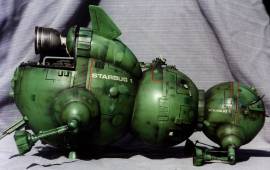
Starbug itself was designed by Alan Marshall and the BBC effects team. Other designs for what had then been called the White Midget were rejected - and when it was pointed out that a white ship crashing into white snow made for troublesome visuals, the ship was altered to green. Between that and the selected design's insect-like shape, the writers elected to change the craft's name to Starbug.
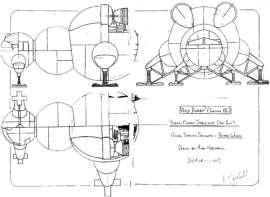
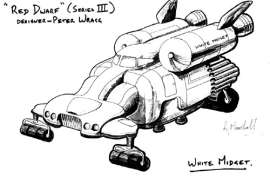
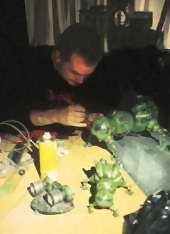
Versions of the robust craft were built many times over, and at various scales. More stock footage had to be prepared (Stabug flying, Starbug leaving Red Dwarf, Starbug coming back) plus some rather more special sections. Within one season, the new ship had been devastatingly crashed no less than three times!
The first, in Backwards, was achieved with video effects (plus some blue screen to show some fish swimming past the cockpit's viewscreen). The second was onto an ice planet constructed in miniature and filmed, as ever, on 35mm film stock in order to slow the footage down. The cause of the crash, a flaming meteorite, was dropped from above the upward-facing ship and filmed sideways on - thus giving the illusion of forward motion to the meteorite, and making the flames flick in a manner that implied zero gravity.
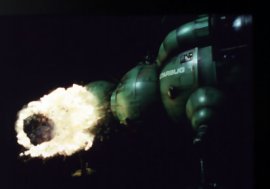
The third crash was in Bodyswap, and came at the end of a protracted chase sequence as Blue Midget pursued Starbug over the surface of a barren planet. This section drew on effects supervisor Peter Wragg's impressive history on Gerry Anderson shows such as Thunderbirds. The models, flying on hidden wires, chased over the massive scaled miniature landscape, and eventually Starbug was literally hurled onto the ground.
Away from the models, yet more bluescreen was employed to show Kryten and the Cat in front of the icy wastes of Marooned, and Lister had already shot scenes on an artificially created snowscape. The 'snow' blowing in the air (actually soap powder) was powered by an extremely loud fan, and Robert Llewellyn in particular suffered as they assaulted his make-up covered eyes.
Polymorph represented the show's most effects-intensive episode yet. Animatronic versions of both the small and large versions beast (the smaller, nick-named Kevin, was voiced by production manager Mike Agnew, who also lent his vocal cords to Bodyswaps's self-destructing vending machine). Sadly the larger model was prone to falling over, and utterly collapsed before the final shot.
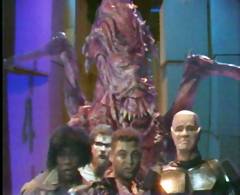
The monster was shot before a blue screen and added to the existing footage larger than its size (to save the building of a forty-foot armour-plated killing machine). One sequence, showing the monster bounding up behind the crew as the open a set of elevator doors, actually doubled up on the chromakey - the Dwarfers were shot in front of the bluescreen, then the monster, and the background image was placed behind that. (More bluescreen was used to insert Lister into stock footage of Adolf Hitler.)
Meanwhile, the backwards photography trick was used one more time to make the shami kebab appear to be throttling Lister. Low tech or not, it remained more effective than the unfortunate substitution of a blatantly fake snake for its live counterpart during the later part of the sequence.
More camera trickery allowed the Polymorph to change form 35 times in rapid succession (36 including the basketball moments later), using the traditional locked-off camera and jump-cuts. In fact, the only problem was the rabbit used at the end of the sequence - it wouldn't sit still for anyone!
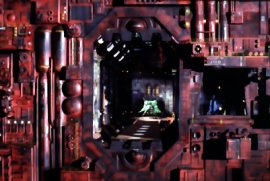
This tech-heavy episode also required the best video effects the show had had to date. The Cat's unfortunate encounter with two heat-seeking laser bolts needed a great many effects shots (not to mention a cardboard box primed to explode with two neat circular shapes on cue). The two heat-seekers were given sound effects by sound supervisor Keith Mayes, who used a technique borrowed from an SF weaponry classic - the Star Wars lightsabers.
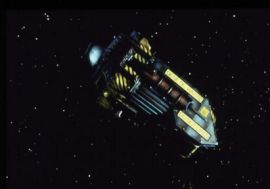
The bolts came, of course, from the newly introduced Bazookoids. The concept of a heavy-duty mining laser adapted for use as a weapon originally included backpacks to provide the Bazookoid's power - although the packs were later abandoned as cumbersome.







 Cover Story
date="20.08.2004"
product="56"
tagline="Series V Art - by Andrew Ellard">
Cover Story
date="20.08.2004"
product="56"
tagline="Series V Art - by Andrew Ellard">